Summer Camps for Working Homeschool Moms: Make the Right Decision
It’s May, and suddenly you’re staring at summer. Homeschool will be done. Your kids will be home more if you are using in-person options for homeschooling. And somewhere in the back of your mind, you’re wondering: Do we need to do summer camps for working homeschool moms this summer? Because yes, camps are everywhere. They’re on Pinterest. And part of you feels like a good mom would sign her kids up for something enriching and structured.
But here’s what nobody says out loud: Summer camps aren’t required. They’re optional. And they’re definitely not one-size-fits-all.
As a working mom who homeschools, you already know that choosing summer camps for working homeschool families looks different for us. We don’t get the traditional “school’s out, camp is on” rhythm. We get to design what summer looks like, which is actually an advantage, if you can get past the guilt.
In this post, I’m walking you through exactly how to figure out what summer actually needs to look like for your family. Not Pinterest’s family. Not your neighbor’s family. Yours. I’ll show you real camp options (some free, some paid, some a mix), how to budget for them without stress, and how to decide what actually fits your schedule and your bank account. And I’ve got a free printable to help you put all of this into action.
By the end, you’ll have a clear picture of what summer could look like and permission to stop overthinking it.

Does Your Family Actually Need Summer Camps for Working Homeschool Moms?
Here’s the truth nobody leads with: Summer camps for working homeschool moms are often sold as essential. Your kids should do camp. They need structure. They need peer time. They need to learn independence.
And maybe that’s true for your family. But maybe it’s not.
Summer camps are one option. One valid option. But they’re not a requirement for working homeschool families, and they’re not a measure of whether you’re doing summer right.
The three real reasons working moms think about camps:
- Kids actually need structure and peer time. Some kids thrive with scheduled activities. They want to be around other kids. They feel bored without direction. For these kids, some form of camp or structured activity genuinely helps.
- You need focused work time. Full-day camps are essentially childcare. If you have work deadlines in June, or a big project in July, camps give you uninterrupted work blocks. That’s valid. That’s real. That’s a legitimate reason to look into camps.
- You feel guilty that good moms do camps. This one is real, too, and I’m naming it because it matters. There’s this underlying cultural message that summer camp is what you do, and if you’re not doing it, you’re somehow letting your kids miss out, or they are getting behind.
Let me be clear: That’s not a reason to do camps. That’s guilt talking. And guilt is a terrible reason to spend money you don’t have or add logistics you don’t need.
Here’s the permission you probably need: If camps don’t fit your budget, your schedule, or your family’s actual needs, then they don’t fit. Your kids will be absolutely fine without them. Some of the most creative, resilient, interesting people didn’t do summer camp. They read books. They played outside. They helped with family projects. They were bored sometimes.
Boredom is not an emergency. And summer without camps is not a failure.
Three Summer Models—And What They Actually Cost
If you decide camps are something you want to explore, here’s how to think about it. There are basically three approaches, and each has real trade-offs.
Model 1: Full-Time Camp (All Summer or Most of Summer)
What it is: Your kids go to the same camp for 8–12 weeks during the summer. Full days. Same place. Consistent schedule.
Real cost: $3,000–$8,000+, depending on your region, the camp, and how many kids you have.
Who it’s for: Moms who need full work days blocked off. Kids who thrive on structure and consistency. Families who’ve budgeted for this.
The honest trade-off: This is a huge financial commitment. Your kids might get camp-fatigued by August. You lose flexibility. And you’re betting that the camp will be worth it all summer long.
Important: If you can’t afford this without going into debt or stressing about money, don’t do it. There’s no camp worth creating financial anxiety for.
Model 2: Patchwork Camps (Mix & Match, 1–3 Weeks Scattered Through Summer)
What it is: Your kids do one or two week-long camps here and there—maybe one in June, one in July, maybe one in August. Different camps, different focuses, scattered throughout the summer.
Real cost: $500–$2,000, depending on what you stack together.
Who it’s for: Moms who need some focused work weeks but can handle gaps in between. Families with multiple kids who need different things. People who want learning to happen but don’t need it to happen all summer.
The honest trade-off: More planning (juggling multiple camp schedules). You still have gaps to fill. But it’s way less expensive, and it gives you breathing room.
This is the model I see most working homeschool moms actually use. It’s the sweet spot—some structure, some flexibility, way more affordable.
Model 3: DIY Summer (Free/Cheap + Home Structure)
What it is: You skip traditional camps. Instead, you use library summer programs, free park days, museum passes, field trips, and structured at-home learning.
Real cost: Free to $500, depending on whether you invest in passes or printables.
Who it’s for: Families on tight budgets. Kids who don’t care about formal camps. Moms who actually want to design summer structure themselves.
The honest trade-off: This requires you to do some planning. It’s not a break from parenting. But it’s doable, legitimate, and your kids will learn just as much.
Permission slip: If this is what works for your family, this is completely fine.
Real Summer Options I Actually Recommend
Now here’s where it gets practical. I’ve found some genuinely good options for working homeschool moms—stuff that actually fits our lives. Some are free. Some are paid. Some are a combination. These are obviously not the only camps out there, but you can use these as a starting point when searching for summer camps for working homeschool moms.
Option 1: FREE Life Skills Summer Camp
What it is: A virtual summer camp with workshops on cooking, gardening, money skills, leadership, technology and online safety, chores and life skills—plus a bunch more.
Time commitment: Flexible. Some content is live, but most is recorded, so you can do it whenever it works. Your kids don’t have to show up at a specific time.
Why it works for working moms:
- Zero cost.
- No transportation (it’s all online).
- Your kids can join during your work breaks, or they can do it on their own schedule.
- The content is actually useful—they’re learning real skills, not just busy activities.

Best for: Kids ages 8–18 who want to build actual skills. Families on tight budgets. Moms who need flexibility over fixed schedules.
My honest take: This is one of those free options that feels too good to be true. But it’s not. Registration opens in May, so if it sounds interesting, grab it now before you forget.
Get the FREE Life Skills Camp here. Registration is open through May.
Option 2: Summer Lit Camp with Book Clubs
What it is: A literature-based camp with live book clubs, creative activities, hands-on projects, and a community of book-loving kids. Book clubs meet live one hour a week (June 4, June 11, June 18 at 12 p.m. CDT), but there are also self-paced activities throughout the summer.
Time commitment: Just one hour per week for the live book clubs, plus whatever self-paced activities your kids want to do.
Why it works for working moms:
- Only one hour a week. You can actually schedule around it.
- Live book clubs mean your kids get peer connection and discussion—but it’s contained and predictable.
- It’s literature-based, so it counts as learning. You don’t have to feel guilty about screen time.
- Your kids actually get excited about it (this is the big one).

Best for: Kids ages 7–14 who love reading. Moms who want learning to happen without planning it themselves. Families who value community but need it in small doses.
Free kickoff event: Before camp officially starts, there’s a FREE live event May 26–27 called “Spring into a Wizarding Adventure.” It’s a great way to try it before you commit.
Cost: $50 USD (use code WHSM at checkout to save $10—making it just $40)
My honest take: If your kids are readers, this is the “easy win” summer activity. One hour a week, zero planning for you, and they’re actually learning and connecting with other kids who love books. Plus, the coupon code saves you $10 right away.
Learn more about Summer Lit Camp and register for the FREE May 26–27 kickoff event
Use code WHSM to save $10 on camp registration.
Option 3: Night Zookeeper Summer Learning Activity Pack
What it is: A downloadable printable pack with 150+ pages of language arts activities, the first Night Zookeeper book, and a full reading comprehension pack.
Time commitment: Totally self-paced. Your kids can do one activity a day, one a week, or a bunch at once. Total control.
Why it works for working moms:
- It’s free.
- You download it once and use it all summer.
- Zero logistics. No signing up for live things. No transportation.
- It’s engaging enough that your kids will actually do it while you work.

Best for: Kids who like independent learning. Families doing DIY summer who want some structure. Anyone who needs activities that require zero setup from you.
My honest take: This is the “fill the gaps” option. Your kids can work through a few pages while you’re on work calls, or you can make it a bigger activity if you want. Total flexibility.
Get the FREE Night Zookeeper pack here
Option 4: My Summer Activity Printable Pack
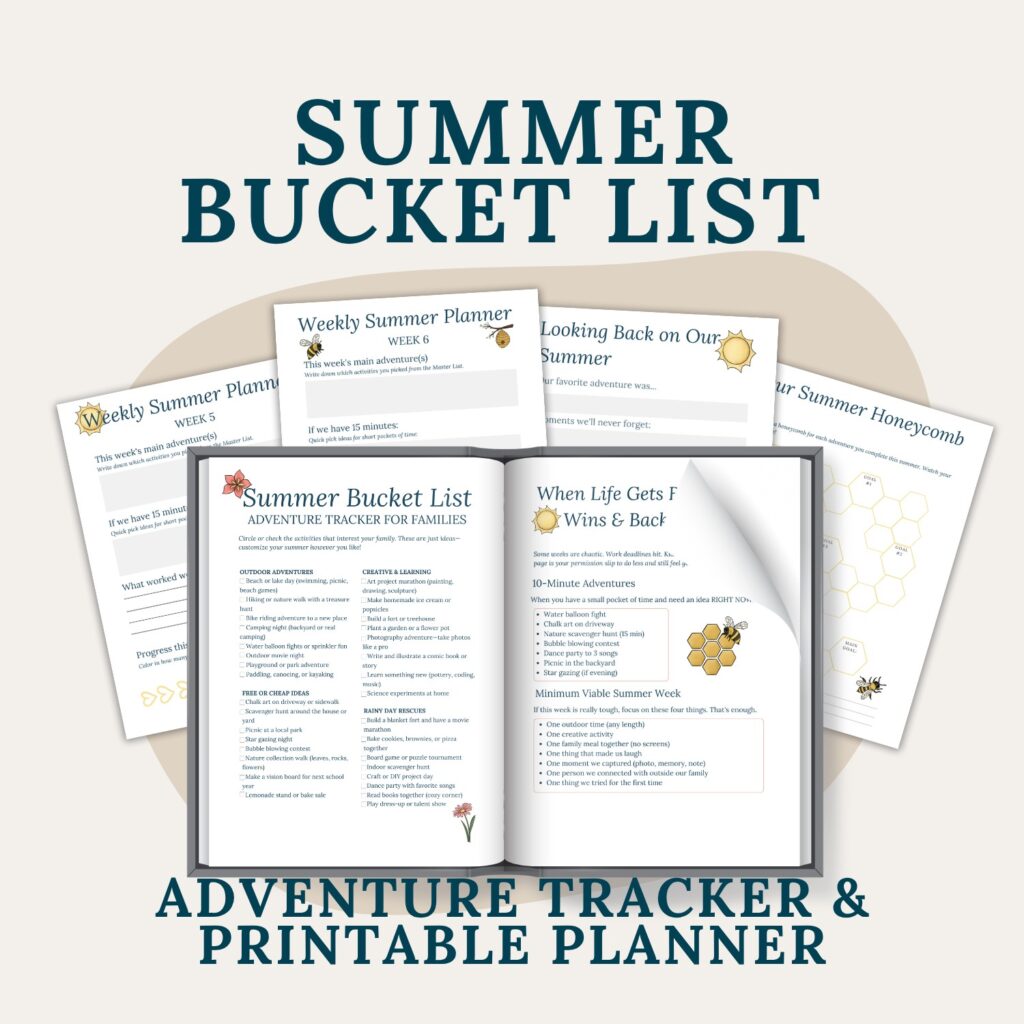
What it is: 26 printable pages + bonus Canva template designed specifically for working homeschool families. Includes bucket lists, monthly planners, weekly adventure trackers, permission pages for busy days, progress trackers, memory pages, and a digital keepsake template.
What’s included:
- Master Bucket List with 30+ pre-picked summer activities (outdoor, creative, free, rainy day)
- Monthly Planning Pages for June, July, August
- Weekly Adventure Planner (6 weeks)
- “10-Minute Wins” & “Minimum Viable Summer Week” pages (permission for busy days)
- Summer Progress Tracker & Goals Page
- Summer Reflection & 3 Memory Pages
- Bonus: Editable Digital Memory Book Canva Template
Time commitment: Mix-and-match. Use what you need, skip what you don’t. The permission pages alone are worth it.
Why it works for working moms:
- Built FOR your real life, not Pinterest.
- You get structure without elaborate planning.
- Mix-and-match means zero guilt—do what works that week.
- Doubles as summer enrichment AND homeschool documentation.
Best for: Families doing patchwork or DIY summer. Moms who want learning + memory-keeping without the stress.
Cost: CAD $9.70 (less than a coffee)
My honest take: I built this for moms like me—you want your kids learning and doing, but you don’t have energy for elaborate projects. The permission pages (“Minimum Viable Summer Week”) alone make it worth it. That’s the real thing working moms need: permission that good enough IS good enough.
Get your Summer Activity Pack here
How to Actually Decide What Fits YOUR Family
Okay, you’ve got options. Now, how do you pick the right summer camps for working homeschool moms?
Here’s the truth: The “right” choice is the one that doesn’t stress your family or your budget. If a choice stresses either one, it’s wrong for you when making decisions about summer camps for working homeschool families.
Start with your constraints, not your wishes:
- Budget: What can you actually spend without stress? Not “what should I spend” or “what would be nice.” What can you actually afford without it taking up mental energy all summer?
- Work schedule: Do you need full-day coverage five days a week? Or do you just need a few focused weeks? Or are you fine with broken-up work days?
- Kids’ needs: Do your kids want camps? Or are you forcing them because you feel like you should? Do they actually need peer time, or are they fine with unstructured days?
- Your sanity: Be real about what adds stress to your life. If coordinating multiple camps sounds like a nightmare, don’t do it. If a fixed schedule stresses you, don’t commit to it.
Here’s how to match your constraints to a model:
Family 1: “I need full childcare coverage all summer.”
- Primary: Full-time local camp ($3k–$8k)
- Secondary: Add the FREE Life Skills Camp for a second kid or for after-camp coverage
- Budget: $3k–$8k
- Extra: Consider whether you really need all summer, or just June and July
Family 2: “I need some focused work weeks, but can figure out the rest.”
- Primary: Patchwork approach—one or two week-long local camps scattered through June and July ($500–$1.5k)
- Secondary: Stack Summer Lit Camp (1 hour/week) + FREE Life Skills workshops
- Filler: FREE Night Zookeeper pack + your Summer Activity Printable Pack
- Budget: $500–$2k total
- Extra: You’ve got coverage for your focus weeks and options for the gaps
Family 3: “We’re on a tight budget, and kids don’t mind unstructured time.”
- Primary: DIY summer—library programs, free park days, free museum hours
- Secondary: Add FREE Life Skills Camp (whatever topics interest your kids) + FREE Night Zookeeper pack
- Optional: Your Summer Activity Printable Pack for a little more structure
- Budget: Free–$50
- Extra: Your kids will be just fine. Unstructured summer is a feature, not a problem.
Family 4: “We want learning + community but minimal time commitment.”
- Primary: Summer Lit Camp (1 hour/week for book clubs) — $40 with code WHSM
- Secondary: FREE Life Skills Camp (pick 1–2 workshops your kids care about)
- Filler: FREE Night Zookeeper pack
- Budget: $40–$50
- Extra: This is the “easy win” approach, you get structure, community, and learning for less than a pizza.
4 Summer Camps For Working Homeschool Moms
Here are those links again, so you don’t have to scroll all the way up:
Budget Breakdown: The Real Numbers
Okay, let’s get specific, because “budget” is abstract until you see actual numbers.
What gets hidden in camp costs:
When you see a camp costs $500/week, that seems manageable. But then you add:
- Transportation ($10–20/day if you’re driving, or $100+ if the camp is far)
- Food/snacks ($5–10/day because camps always need snacks)
- Registration fees ($25–50 per camp)
- Extras (field trip fees, T-shirt, supplies)
So a $500 camp week actually costs closer to $700 when you add it all up.
How to work backwards from YOUR budget:
Step 1: Decide what you can actually spend. Not “what’s reasonable.” What you can actually spend without it keeping you up at night.
Let’s say it’s $2,000.
Step 2: Subtract hidden costs. $2,000 – $500 in transportation, food, and extras = $1,500 for actual camp fees.
Step 3: See what that buys you. $1,500 might be:
- Three one-week camps at local parks ($400–500/week)
- OR one full month at a cheaper camp + one shorter camp
- OR two patchwork camps + the free/low-cost options stacked
Step 4: Choose based on what actually fits your life.
Real example:
Your budget: $1,200 for the whole summer.
Your work needs: Two focused weeks in June and July, where you need full-day coverage.
What you’d actually do:
- Week-long camp in June ($500 + $100 extras = $600)
- Week-long camp in July ($500 + $100 extras = $600)
- Total spent: $1,200
- Gaps filled with: FREE Life Skills workshops + FREE Night Zookeeper pack + your Summer Activity Printable Pack
You’ve got your coverage weeks, your budget is met, and you have options for the rest.
How to Make This Decision
Okay, here’s the process so you don’t just think about this forever:
This week:
- Figure out your constraints (budget, work schedule, kids’ actual wants)
- Pick which model actually fits (full-time, patchwork, DIY)
- Download the Summer Camp Decision Matrix (below) and fill it out
Next week:
- If you’re doing the patchwork or DIY model, grab the free resources that fit
- If you’re doing camps, start researching local options that match your budget
- If you’re doing a mix, stack your choices and write it down
Before Memorial Day:
- Make a decision and commit to it
- Register for camps OR grab your free resources
- Tell your kids what’s happening (give them a choice within what you’ve decided, if possible)
- Move on. Don’t second-guess it.
The permission you need: You don’t have to make a perfect summer. You just have to make a summer that works. And anything that works for your family—camps, no camps, patchwork camps, DIY camps, or whatever—is the right answer.
Frequently Asked Questions About Summer Camps for Working Homeschool Moms
“Should we do camps?” Only if your budget, schedule, and kids’ preferences all align. If one of those three is a no, then it’s not the right choice for you.
“Will my kids be bored without camps?” Some boredom is actually good for kids. It makes them creative. It teaches them to entertain themselves. It’s not an emergency.
“Is DIY summer as good as ‘real’ camps?” Completely depends on what your kids learn and how engaged they are. A kid doing meaningful projects at home learns as much as a kid at camp. The setting doesn’t matter as much as the engagement.
“Should I feel guilty if we can’t afford camps?” No. Not even a little. Working and homeschooling and paying for everything else is already expensive. If camps don’t fit your budget, skip them. Your kids will be fine.
“What if my kids are begging for camps?” That’s different. If your kids genuinely want to go, that’s worth considering. But ask them why. Do they want the specific camp? Or do they just want something to do? There’s a difference.
“Can I mix camps and DIY?” Yes. That’s actually the smartest approach. Stack a week-long camp with free resources and at-home projects.

Summer for working homeschool moms choosing camps doesn’t have to look like Pinterest. It doesn’t have to cost a fortune. It doesn’t have to be perfectly structured or perfectly unstructured.
It just has to work for your family.
Maybe that’s summer camps for working homeschool moms. Maybe that’s free resources. Maybe it’s a mix. Maybe it’s your kid reading all summer and that’s enough. None of those is wrong.
You’ve got options now. Real options—some free, some paid, some a mix. You know your budget. You know your constraints. You know what your family actually needs.
That’s enough to make a decision.
Summer Camp For Working Homeschool Moms Decision Matrix
Ready to actually decide? Download the Summer Camp Decision Matrix below—a one-page guide to help you map out your constraints, see which model fits, and decide what summer actually needs to look like for your family.
Download Your FREE Summer Camp Decision Matrix (Instant Download via Google Drive link). Printing problems? Be sure your Adobe Acrobat Reader (free) is up-to-date.
It takes 10 minutes to fill out, and by the end, you’ll know exactly what summer looks like for you. No more wondering. No more guilt. Just a real plan that actually works.
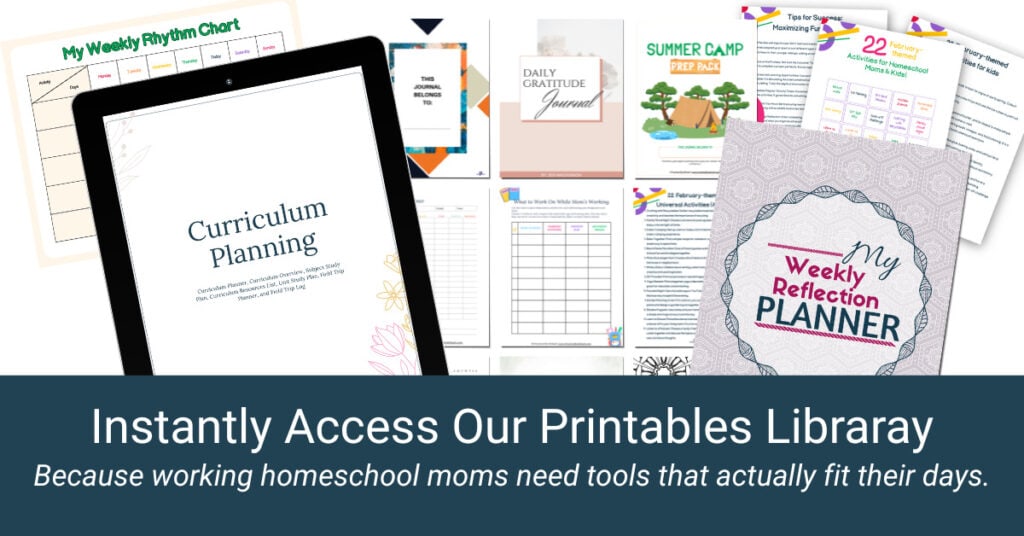
And if you want more structure-without-stress ideas for summer (or the whole year), the Practical Printable System has planners, activity packs, and everything else designed for busy families like ours.
Explore the Practical Printable System
You’ve got this. Summer doesn’t have to be perfect. It just has to work.

Jen Mackinnon is a working homeschool mom and time management strategist who’s been juggling careers, kids, and homeschooling for 14+ years. She specializes in helping busy moms find simple, meaningful ways to celebrate milestones without adding stress to their schedules. On this blog, she shares practical systems and real-life strategies for working homeschool families.You are warmly invited to join the Online Community Here!